Quick answer
How do you set milestones for a freelance project?
To set milestones for a freelance project, split the work into three to six stages, give each stage a clear and checkable "done" point, a date and an owner, and link a part of the payment to each one. Review and sign off every milestone in writing before the next stage starts.
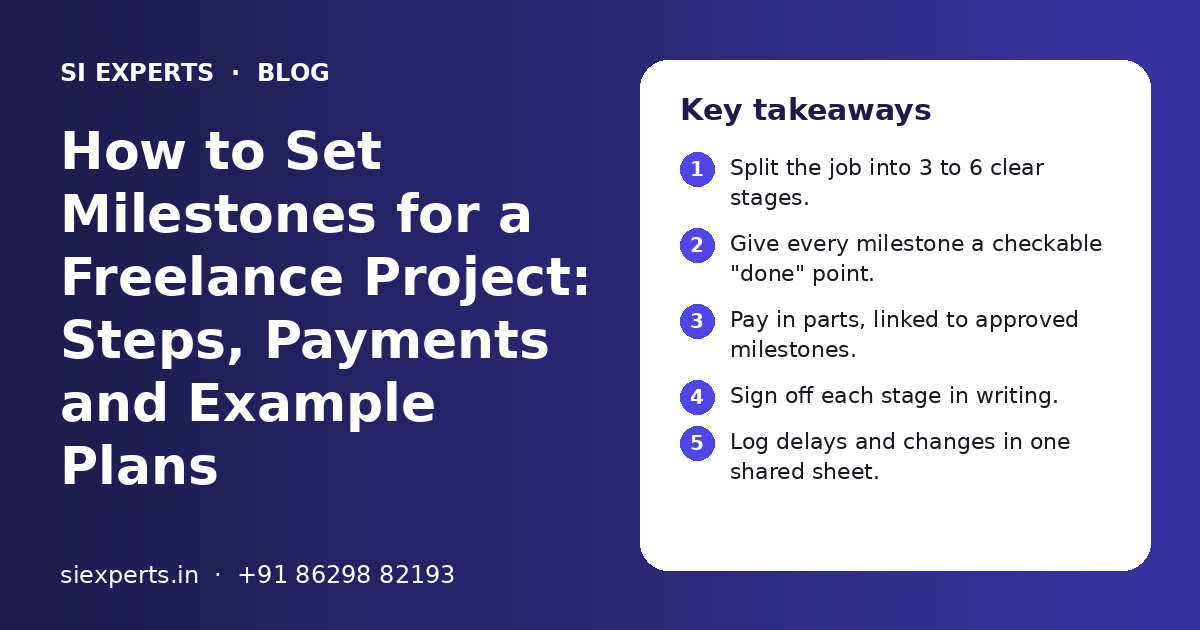
Key takeaways
- Split the job into 3 to 6 clear stages.
- Give every milestone a checkable "done" point.
- Pay in parts, linked to approved milestones.
- Sign off each stage in writing.
- Log delays and changes in one shared sheet.
What is a project milestone and why does it matter?
A milestone is a fixed point in a project where a set piece of work is finished and checked. It matters because it lets you see progress, pay fairly and catch problems early, instead of waiting until the very end.
When you hire a freelancer or remote expert, you cannot see them working each day. Milestones solve this. You get something real to look at every week or two. If the work goes wrong, you find out after one stage, not at the end.
Knowing how to set milestones for a freelance project is useful for any kind of work. You can use the same method when you hire web development experts, SEO experts, designers or writers.
How do you break a freelance project into milestones?
Start from the final result and work backwards. List the big parts of the job, put them in order, and turn each part into a stage with a clear output you can see or test.
Your project brief is the starting point. If you have not written one yet, read our guide on how to write a project brief for a freelancer first. The milestones then come from the deliverables in that brief.
- 1
Write the final result in one line
For example, "a live five-page website with a contact form and WhatsApp button".
- 2
List the main parts of the work
Write every big task, such as planning, design, build, content, testing and launch.
- 3
Group and order the parts
Put tasks that belong together in one stage. Put stages in the order they must happen. Design usually comes before build, and testing before launch.
- 4
Keep three to six stages
Fewer gives too little control. More adds paperwork. Big projects can have phases, each with its own milestones.
- 5
Give each stage a clear output
Each milestone should end in something you can open, click, read or test, like a design file, a staging link or a report.
- 6
Add dates and owners
Set a target date for each stage, name who approves it and include your own review days.
- 7
Agree the plan in writing
Share the milestone list with the expert, fix any gaps and keep the final version in your contract or scope.
What makes a milestone clearly "done"?
A milestone is done when it meets written acceptance points that anyone can check. "Looks good" is not a done point. "All five pages work on mobile and the form sends email to your inbox" is a done point.
Write two to five acceptance points for each milestone. Keep them simple and checkable. Use numbers, links and yes-or-no tests where you can.
| Weak milestone | Clear milestone with done point |
|---|---|
| Design the website | Home and inner page designs shared in Figma, with mobile and desktop views, and one round of changes done |
| Do SEO | Keyword list of 40 terms approved, title and meta tags updated on 10 service pages, report shared |
| Build the app | Login, signup and profile screens work on the test build on Android, with no blocking bugs |
| Write content | Six service pages written, checked for spelling, uploaded to WordPress as drafts |
| Launch | Site live on the main domain, forms tested, backup taken, old links redirected |
- The output can be seen, opened or tested
- There are two to five written acceptance points
- The date and the approver are named
- Out-of-scope items for that stage are written down
- The number of change rounds is agreed
How should you link payments to milestones?
Link each payment to an approved milestone, not to a date alone. A common pattern is a small advance at the start, part payments after key stages, and the last part after launch or final handover.
This way the expert is paid for real progress, and you only pay for work you have checked. Write the payment split in the contract. Our guide on what to include in a freelancer contract covers the legal side, so here we focus on how payments match the stages.
| Payment point | Linked to | Why it helps |
|---|---|---|
| Advance | Signed scope and kick-off | Shows commitment from both sides |
| Part payment 1 | First major milestone approved | Pays for planning or design work |
| Part payment 2 | Main build or delivery approved | Pays for the largest share of effort |
| Final payment | Launch, handover and access transfer | Keeps focus until the very end |
- Pay by bank transfer or UPI and note the milestone name in the payment remark.
- Ask for a GST invoice for each payment if the expert or agency is GST registered.
- Do not pay the final part before you get admin access, source files and passwords for your own accounts.
The split depends on the job, the expert and the risk. You get a clear quote after a free call, and the payment plan is agreed along with it. If your work is ongoing, compare models in our guide on hourly vs monthly vs project hiring.
Need help with your project?
Talk to the SI Experts team. Free first call, simple advice, clear quote.
What do example milestone plans look like?
Below are three sample plans: a small business website, one month of SEO work and a simple mobile app. Use them as a starting point and change the stages to fit your own job.
Example 1: Small business website
| Milestone | Done when | Payment link |
|---|---|---|
| 1. Plan and sitemap | Page list, sitemap and content plan approved | Advance |
| 2. Design | Home and inner page designs approved after agreed change rounds | Part payment 1 |
| 3. Build on staging | All pages built on a test link, forms and WhatsApp button working | Part payment 2 |
| 4. Content and testing | Content uploaded, mobile and browser checks done, bug list cleared | None |
| 5. Launch and handover | Site live, backup set, logins and files handed over | Final payment |
Example 2: One month of SEO work
| Week | Milestone | Done when |
|---|---|---|
| Week 1 | Audit and keyword list | Audit shared, keyword list approved |
| Week 2 | On-page fixes | Titles, metas and headings updated on agreed pages |
| Week 3 | Content and local listing | Agreed blog or service page content live, Google Business Profile updated |
| Week 4 | Report and next plan | Report shared on a call, next month plan agreed |
SEO results take time, so milestones for SEO should be about tasks done, not rankings promised. Judge the quality of each task, and use our guide on how to check freelancer work quality to review it.
Example 3: Simple mobile app
| Milestone | Done when |
|---|---|
| 1. Screens and flow | Wireframes for all screens approved |
| 2. UI design | Final screen designs approved by a UI/UX designer review |
| 3. Core features | Login, main feature and payments working on a test build |
| 4. Testing | Tested on agreed Android and iPhone devices, blocking bugs fixed |
| 5. Store release | App submitted to stores from your own developer accounts |
For app work, keep the store accounts in your company's name. A mobile app developer can submit the app from your account with a user role.
How do you review and sign off a milestone?
Review each milestone against its written done points, list any issues in one message, and give a clear written sign-off once they are fixed. Do not approve by silence or by a thumbs-up emoji alone.
- The expert shares the output with a short note on what was done.
- You check each acceptance point, one by one, on the real link or file.
- You send all feedback in one list, not in many small messages.
- The expert fixes the issues within the agreed change rounds.
- You send a written sign-off by email or in the project tool.
- The payment for that milestone is released and the next stage starts.
Name one person who gives sign-off, and set a review window, such as two or three working days. Many delays come from slow client feedback, not from the expert.
How do you handle delays and change requests?
Handle delays by talking early and moving dates in writing. Handle change requests by writing them down, checking if they are in scope, and agreeing any extra time or cost before work starts.
When a milestone is late
Ask the expert for the reason and a new date. A short delay with a clear reason is normal. Many missed dates in a row, or no reply at all, is a warning sign. Our guide on what to do if a freelancer stops responding explains the next steps.
When you want to change something
- 1
Write the change
Describe what you want in a few lines, with a screenshot if it helps.
- 2
Check the scope
See if the change is part of the agreed milestone or new work.
- 3
Ask for impact
Ask the expert how it affects time and cost.
- 4
Agree before starting
Approve the change in writing and update the milestone plan.
Which tools help you track milestones?
A shared Google Sheet or a Trello board is enough for most freelance projects. Bigger teams may use tools like Asana, Jira or ClickUp, but the method stays the same.
| Tool | Good for | Watch out for |
|---|---|---|
| Google Sheet or Excel | Simple list of milestones, dates, status and payments | Needs someone to update it each week |
| Trello | Visual board with one card per milestone and checklists inside | Cards can pile up without clear owners |
| Asana, ClickUp or Jira | Larger projects with many tasks and people | Can be too heavy for a small job |
| WhatsApp group | Quick daily questions and alerts | Decisions get lost, so copy them to the sheet or board |
A simple sheet can have these columns: milestone, done points, owner, approver, target date, status, sign-off date, payment status and notes. Share it with edit access for both sides.
What mistakes should you avoid when setting milestones?
The biggest mistakes are vague done points, too many or too few stages, paying everything upfront, slow feedback and agreeing changes only on calls. Each one leads to delays or disputes.
Do this
- Write checkable done points for each stage
- Keep three to six milestones per phase
- Link payments to approved work
- Plan time for your own review
- Record changes and approvals in writing
Avoid this
- "Phase 1 complete" with no details
- Paying the full amount before work starts
- Holding the final payment for months with no reason
- Adding new features quietly inside a milestone
- Leaving testing and handover out of the plan
Also, do not skip a small trial if you are unsure about an expert. Our guide on how to test a freelancer before hiring shows how a paid test task can work as a first mini milestone.
SI Experts is powered by Shivah Web Tech, with an 11+ year parent team, 25+ in-house specialists and 500+ projects. Every project we take on is split into clear stages with named owners. You can hire one expert, or a dedicated team in India, and agencies can use our white label agency partner model. Share your project idea and you get a clear quote and a milestone plan after a free call.
Frequently Asked Questions
How many milestones should a freelance project have?
Most small and medium freelance projects work well with three to six milestones. A small job like a landing page may need only three: plan, build and launch. A bigger website or app can be split into phases, and each phase can have its own three to six milestones. The aim is enough control to catch problems early without adding too much paperwork.
Should I pay a freelancer in advance before the first milestone?
A small advance is common and fair, because it shows you are serious and covers the start of the work. Keep it as a part of the total, not the full amount. Link the rest of the payments to approved milestones. Always get a written scope and milestone plan before you pay any advance.
What if I am not happy with a milestone?
Check the work against the written done points for that milestone. List every issue clearly in one message and ask for fixes within the agreed change rounds. If the work meets the done points but you still want changes, treat it as a change request. This is why clear done points matter so much at the start.
Who should write the milestone plan, me or the freelancer?
It works best when both sides help. You know the goal, the deadline and your review time. The freelancer knows how the work is usually done and where natural break points are. Ask the expert for a draft plan, compare it with your brief, fix gaps, and then agree the final version in writing.
How do I handle a freelancer who keeps missing milestone dates?
First ask for the reason and a realistic new date in writing. If delays keep happening, check if your feedback or content was late too. If the delays are on their side and continue, pause new work, pay only for approved milestones, and collect all files and access. Then decide if you should move to another expert.
Can SI Experts give me a milestone plan before I hire?
Yes. On a free call we learn about your goal, deadline and budget range. Then we share a scope with clear milestones, done points and a payment plan linked to each stage. You can review it, ask questions and change it before you agree, so you know what you get at each step.